
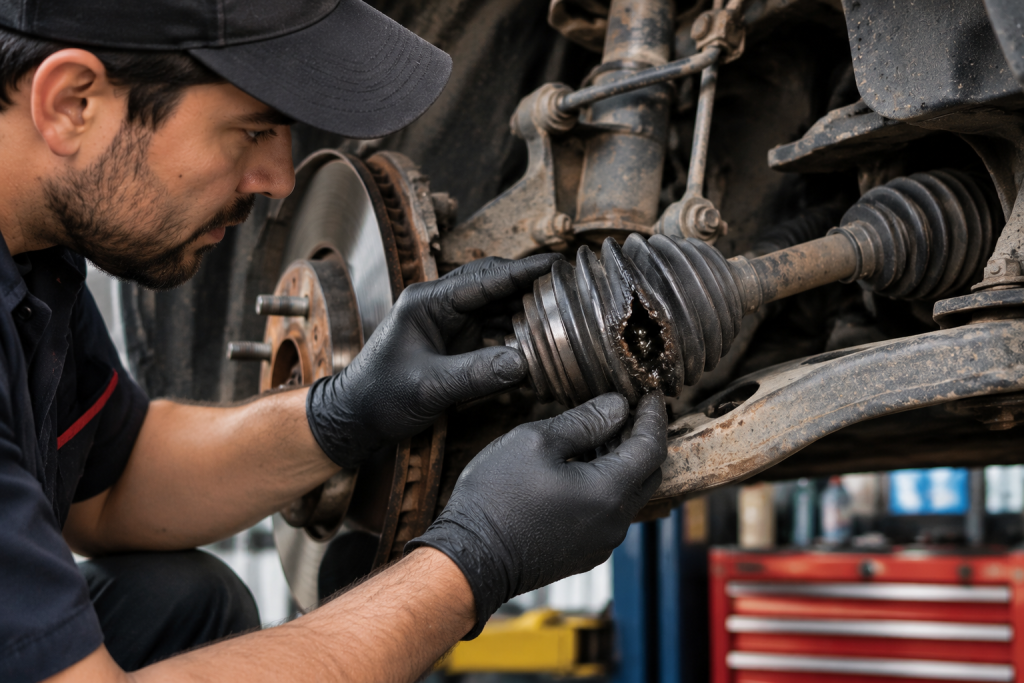
You pull out of a parking lot, turn the steering wheel and hear it: a rhythmic click, click, click that gets faster as the car speeds up. It might disappear when you drive straight and come right back on the next turn. That sound is one of the most recognizable signs of a worn CV axle, and it is a problem you should not ignore. CV axles are tough parts, but they depend on a small rubber boot and a supply of grease to survive. When either one fails, the joint starts to wear quickly. This guide explains what a CV axle is, what causes the clicking, how to tell it apart from other noises, what a repair involves and how to help your axles last longer. If you are searching for CV axle repair in El Paso, here is what to know.
What a CV Axle Does
CV stands for constant velocity. On most front wheel drive and all wheel drive vehicles, and on many four wheel drive and rear wheel drive vehicles with independent suspension, CV axles carry power from the transmission or differential to the wheels. Each axle has a joint at each end. The joints allow the axle to keep delivering smooth power while the wheel moves up and down with the suspension and turns left and right with the steering.
- The outer CV joint sits near the wheel. It handles the steep angles that come with steering, so it is the one that usually makes the clicking noise when it wears.
- The inner CV joint sits near the transmission or differential. It slides in and out as the suspension moves, and when it wears, it tends to cause vibration or a clunk.
- The CV boots are flexible rubber or plastic covers that seal each joint. They hold in the grease that lubricates the joint and keep out dirt, water and grit.
Why a CV Axle Clicks
Inside each joint are bearings that roll in precisely shaped tracks. When the joint wears, the bearings and tracks no longer fit as they should, and there is play in the joint. As you turn and put the joint through a steep angle while it is carrying power, that play shows up as a click or pop. The sound is usually most noticeable in sharp, slow turns, such as in a parking lot, and when accelerating through a turn.
The most common reason a joint wears out is a torn or damaged boot. Once the boot splits, grease escapes and dirt gets in. Without lubrication and with abrasive grit inside, the joint wears fast. Over time the clicking gets louder and more frequent.
What Damages CV Boots
- Age and wear. Rubber hardens and cracks over time.
- Heat. Long periods of high temperature can dry out and crack rubber, and the underside of a vehicle gets hot, especially near the exhaust and brakes.
- Dust and grit. Fine dust can work into small cracks and speed wear, and it makes a torn boot much more damaging.
- Road debris. Rocks, curbs and rough roads can cut or tear a boot.
- Impacts. Potholes and hard hits can damage the boot, clamp or axle.
- Loose or failed clamps. The boot is held on by clamps, and if one comes loose, grease can leak out even without a tear.
- Previous repairs. A boot that was installed poorly can fail early.
Environments with strong sun, high temperatures and a lot of dust are hard on rubber parts like these. Our post on desert dust and heat and keeping your car running in El Paso explains how those conditions affect a vehicle, and our desert heat car care tips offer more practical ideas.
Signs of a Failing CV Axle
- Clicking or popping when turning. This is the classic sign, and it typically gets worse in tight turns and under acceleration.
- Grease flung around the inside of the wheel, on the suspension parts or under the car. A torn boot often leaves dark, greasy splatter.
- A torn, cracked or loose boot that is visible when the wheels are turned or the car is raised.
- Vibration while driving, especially under acceleration. A worn inner joint is often the cause.
- A clunking sound when shifting between drive and reverse or when letting off and getting back on the gas.
- A shudder when accelerating from a stop.
If you notice any of these signs, have the car inspected. A damaged boot caught early may save the joint, and a joint that is badly worn can fail further if it is ignored.
Other Noises That Can Sound Similar
Not every click when turning is a CV axle. Other possibilities include:
- A worn wheel bearing. This usually causes a hum or growl that changes with speed and may change when you steer.
- Worn tie rod ends or ball joints. These can clunk or knock over bumps or when turning.
- Worn strut mounts or bearings. These can pop or creak when the steering wheel turns, particularly at low speeds.
- Sway bar links or bushings. These can clunk or rattle over uneven roads.
- Brake components. Loose hardware or a worn part can click or clunk.
- Loose lug nuts or wheel problems. A loose wheel is a serious hazard, so if you hear a click that seems tied to wheel rotation, pull over safely and have it checked.
- A rock or object caught in the tire tread or the brake dust shield.
Because these noises can overlap, a hands on inspection is the best way to find out what is happening.
Why You Should Not Ignore It
A clicking CV joint will not repair itself. As wear continues, the play grows and the joint can eventually fail. A failed axle can cause loss of power to that wheel, and in the worst cases the axle can separate. That can leave the car stranded, and depending on the circumstances, it can cause a loss of control. Fixing the problem early is usually easier than dealing with it after it fails. If the clicking is loud, the vibration is strong or the car feels unsafe, stop driving and have it towed or inspected where it is.
How a CV Axle Problem Is Diagnosed
A technician typically starts with a conversation about when the noise happens. Then they inspect the vehicle, which often includes:
- Looking at the boots for cracks, tears, loose clamps and grease leaks.
- Checking the axle joints for play and roughness.
- Test driving, including turning in both directions at low speed.
- Inspecting related parts such as wheel bearings, tie rods, ball joints and suspension components.
- Checking the wheels and lug nuts.
How CV Axles Are Repaired
The repair depends on how much damage there is.
- Boot replacement. If the boot is torn but the joint is not yet worn and still clean, replacing the boot and repacking the joint with fresh grease may be possible. This only works if the problem is caught early.
- Axle replacement. If the joint is worn, clicking or contaminated, the usual repair is to replace the whole axle assembly. Many technicians prefer this, because it is a complete fix and often a more reliable one than rebuilding the joint.
The job involves removing the wheel, separating the axle from the suspension and the transmission or differential, installing the new axle and tightening everything to the manufacturer’s specifications. It is not a beginner job. It involves critical safety parts, specific torque values and special tools. Your technician may also recommend checking related parts while the area is open, and in some cases an alignment check afterward. Replacing axles in pairs is sometimes suggested if both show wear, but it depends on the condition of each.
How to Help Your CV Axles Last
- Have the boots inspected at regular service visits, especially when the car is on a lift.
- Fix torn boots promptly. A small tear is far easier to deal with than a ruined joint.
- Avoid driving hard over curbs, potholes and rough terrain when you can.
- Avoid aggressive acceleration with the wheels turned all the way.
- Use quality replacement parts and proper installation.
- Pay attention to new noises and vibrations and do not wait for them to get worse.
- Keep up with suspension and alignment maintenance.
How a Mobile Mechanic Can Help
Many CV axle inspections and replacements can be done at your home or workplace. A mobile mechanic can look at the boots, check for play and leaks, test drive the car and tell you what is making the noise. For many vehicles, an axle replacement can be done on site, which saves you from towing a car that is still drivable. Some vehicles need a lift, special tools or a shop environment, and a good technician will tell you honestly what can be done where you are. If you have any concern that a wheel is loose or the car is unsafe, do not drive it. Have it inspected first.
Quick CV Axle Checklist
- Listen for clicking or popping when turning.
- Look for grease on the inside of the wheel or underneath.
- Notice vibration or clunking when accelerating.
- Rule out other causes with a proper inspection.
- Do not ignore a torn boot.
- Do not drive with a loose wheel or a severe vibration.
- Have the axle repaired before it fails.
A clicking sound is your car telling you something is wearing out. If you would like help finding out what is causing yours, visit the Mobile Mechanic Pros of El Paso homepage to learn more, or contact us to schedule a visit.